Boosting JSON.stringify Performance: A Step-by-Step Guide to V8's Optimizations
Introduction
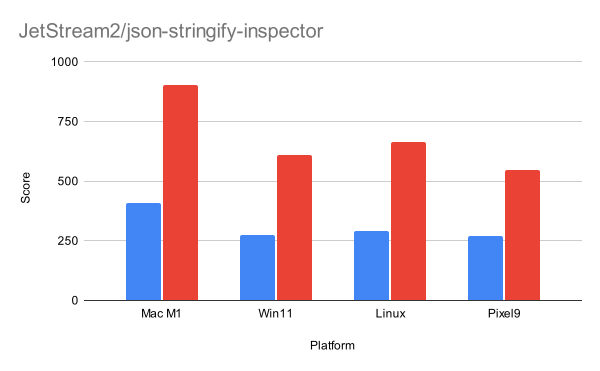
JSON.stringify is a core JavaScript function for serializing data, directly affecting common web operations—from network requests to storing data in localStorage. A faster JSON.stringify leads to quicker page interactions and more responsive applications. Recent engineering efforts in V8 have made JSON.stringify more than twice as fast. This guide walks through the key optimizations that made this improvement possible, providing a step-by-step approach to understanding and implementing similar performance gains.
What You Need
- Basic understanding of JavaScript engines (V8) and garbage collection
- Familiarity with data serialization concepts
- Access to V8 source code or a similar engine for reference (optional)
- Interest in performance optimization and low-level programming (C++ for engine modifications)
Step-by-Step Guide
Step 1: Establish a Side-Effect-Free Fast Path
The foundation of the optimization is a fast path built on a simple premise: if serialization is guaranteed to trigger no side effects, a much faster, specialized implementation can be used. A side effect here is anything that breaks the simple streamlined traversal of an object—such as executing user-defined code during serialization or internal operations that trigger garbage collection.
To implement this, the engine must analyze the object graph before serialization:
- Identify objects containing only plain data (simple types, arrays, or nested plain objects).
- Avoid objects with custom
toJSONmethods, getters, or proxies. - Ensure no subtle internal operations (like
ConsStringflattening) will cause a GC cycle.
As long as V8 can determine the serialization will be side-effect-free, it can bypass many expensive checks and defensive logic, resulting in significant speedups for the most common JavaScript objects.
Step 2: Switch from Recursive to Iterative Traversal
The new fast path uses an iterative approach instead of the traditional recursive one. This architectural change eliminates the need for stack overflow checks and allows quick resumption after encoding changes. Developers can now serialize significantly deeper nested object graphs than previously possible.
Implementation details:
- Use a stack-like structure (e.g., a
std::vector) to manage nested objects manually. - Avoid recursion altogether to keep stack usage predictable and low.
- Handle loops in object graphs by tracking visited references if needed (though JSON.stringify doesn't support cycles natively; but for safety, implement depth limits).
Step 3: Templatize the Stringifier on Character Type
Strings in V8 can be represented using one-byte (ASCII) or two-byte (UTF-16) characters. A string containing only ASCII characters uses 1 byte per character; if any character lies outside the ASCII range, the whole string uses 2 bytes per character, doubling memory usage. To avoid branching and type checks during serialization, the entire stringifier is now templatized on the character type.
Steps:
- Compile two distinct specialized versions of the serializer: one fully optimized for one-byte strings, another for two-byte strings.
- This increases binary size but yields substantial performance gains.
- At runtime, the engine chooses the appropriate implementation based on the string's representation, eliminating branch mispredictions.
Step 4: Efficiently Handle Mixed Encodings
During serialization, each string's instance type must be inspected to detect representations that cannot be handled on the fast path (e.g., ConsString, which might trigger GC during flattening). The implementation handles mixed encodings efficiently by:
- Checking the instance type early to decide if a fallback to the slow path is necessary.
- For strings that are already one-byte or two-byte, processing them directly in the corresponding specialized path.
- Minimizing the overhead of this check by integrating it into existing traversal.
This ensures that the fast path works for the majority of real-world data, which often contains a mix of ASCII and non-ASCII characters.
Step 5: Optimize Memory and Defensive Checks
The general-purpose serializer includes many defensive checks (e.g., for circular references, custom toJSON, valueOf, etc.). In the fast path, these checks are reduced to only those absolutely necessary, with the assumption that side effects are absent:
- Skip stack overflow checks (thanks to iterative approach).
- Assume no valueOf or toString calls on objects in the fast path.
- Assume all strings are either one-byte or two-byte flat strings (no ConsString or SlicedString).
However, care must be taken to validate these assumptions during the side-effect-free analysis (Step 1). If any assumption fails, gracefully revert to the slow path.
Conclusion Tips
- Test with realistic workloads: The fast path yields the most benefit for plain data objects. Measure performance improvements with typical JSON payloads from your application.
- Understand limitations: The fast path cannot handle objects with custom serialization logic. For such cases, the engine must fall back to the slower, general-purpose path. See Step 1 for details on side-effect detection.
- Monitor memory: Templatizing the stringifier increases binary size. In resource-constrained environments, weigh the trade-off between speed and memory.
- Stay updated: These optimizations are present in V8 version X and later. Ensure your JavaScript runtime is up-to-date to benefit from the speed improvements.
- Avoid anti-patterns: To maximize the chance of hitting the fast path, avoid using getters, proxies, or custom
toJSONon objects that are frequently serialized.