Transforming Man Pages into User-Friendly Documentation: A Practical Guide
Overview
Man pages are the backbone of Unix-like systems documentation, yet they often frustrate users who need quick answers. After spending months refining Git man pages and creating cheat sheets for tools like tcpdump, dig, and Git itself, I realized a core issue: man pages pack immense detail but lack navigability. This guide explores how to infuse man pages with the clarity of a cheat sheet without losing their comprehensive nature. By studying standout examples—like rsync's options summary, strace's categorized options, and Perl's dedicated cheat page—we’ll build a three-part strategy to transform any man page from a daunting wall of text into a practical reference tool. The goal? Make the man page itself the first place users turn to, not the last.
Prerequisites
- Familiarity with basic Unix commands (e.g., ls, grep, man).
- Experience reading man pages to understand their standard structure (SYNOPSIS, OPTIONS, EXAMPLES).
- Access to a text editor and a system with
maninstalled (any distribution works). - Optional: familiarity with
grofformandocformatting; however, the guide focuses on content structure, not low-level syntax.
Step-by-Step Instructions
1. Add an Options Summary Section
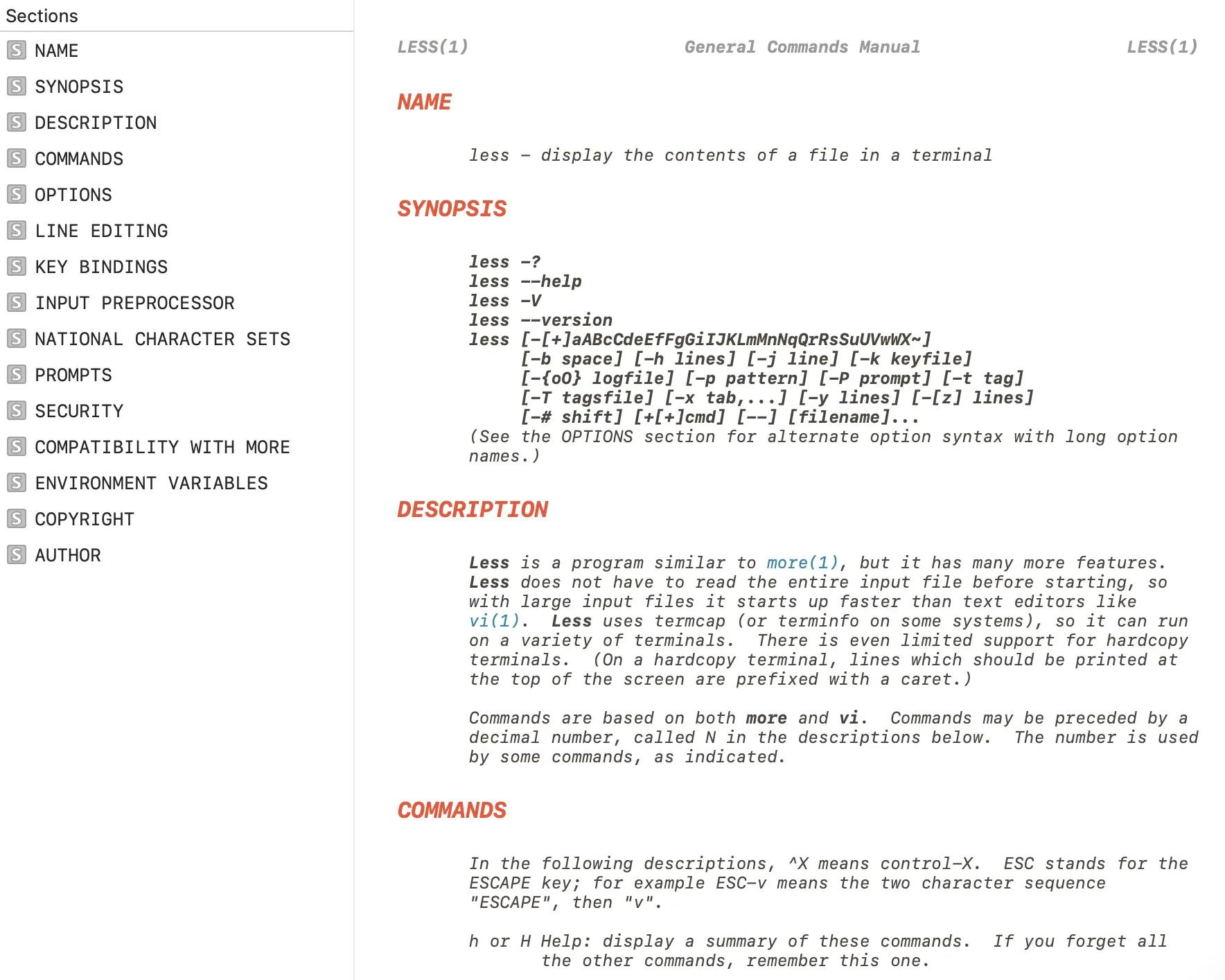
The SYNOPSIS of many man pages lists all flags in a single, often cryptic string: ls [-@ABCFGHILOPRSTUWabcdefghiklmnopqrstuvwxy1%,]. This is nearly impossible to parse. The rsync man page offers a brilliant alternative: keep the SYNOPSIS terse (e.g., rsync [OPTION...] SRC... [DEST]) and introduce a dedicated OPTIONS SUMMARY section that provides a one-line description for each flag.
--verbose, -v            increase verbosity
--info=FLAGS             fine-grained informational verbosity
--debug=FLAGS            fine-grained debug verbosity
--stderr=e|a|c           change stderr output mode (default: errors)
--quiet, -q              suppress non-error messages
--no-motd                suppress daemon-mode MOTD
To implement this in your own man page:
- Replace the complex SYNOPSIS with a simplified line.
- Immediately after SYNOPSIS (or before the full OPTIONS section), add an OPTIONS SUMMARY subheading.
- List each option with its short and long forms (if any), aligned in a table-like format using tabs or spaces. Keep descriptions to ≤60 characters to fit 80-column terminals.
- Follow this with the traditional OPTIONS section that elaborates on each flag.
2. Organize Options by Category
Alphabetical ordering works well for dictionaries, but man pages often bury related flags. The strace man page groups options under categories like “General,” “Startup,” “Tracing,” “Filtering,” and “Output Format.” This mirrors how users think: “I need a tracing option, not any random flag.”
To apply this to grep (as I experimented with):
- Audit all options and group them logically. For example:
- Basic filtering:
-e,-f,-i,-v - Output control:
-l,-L,-c,-o,-n,-b - Context lines:
-A,-B,-C,-a,-s - File and directory handling:
-r,-R,-d,--exclude - Performance:
-F,-P,-E,-w,-x
- Basic filtering:
- In the OPTIONS section, replace or augment alphabetically sorted entries with category headings. For instance:
BASIC FILTERING -e PATTERN, --regexp=PATTERN -f FILE, --file=FILE -i, --ignore-case -v, --invert-match OUTPUT CONTROL -l, --files-with-matches -L, --files-without-match -c, --count -o, --only-matching -n, --line-number -b, --byte-offset - Ensure each option still appears in the summary or index so users can find it via
/search.
This structure dramatically reduces the time to locate, say, the -l flag (which I always forget). The category “Output Control” immediately hints at its purpose.
3. Incorporate a Cheat Sheet Section
A cheat sheet is a dense, ASCII-friendly reference that covers core syntax. The Perl documentation includes man perlcheat, which displays common constructs in a compact 80-column table:
SYNTAX
foreach (LIST) { }     for (a;b;c) { }
while   (e) { }        until (e)   { }
if      (e) { } elsif (e) { } else { }
unless  (e) { } elsif (e) { } else { }
given   (e) { when (e) {} default {} }
To add a cheat sheet to your man page:
- Create a new section titled CHEAT SHEET (or QUICK REFERENCE).
- Extract the most frequently used flags, common command patterns, and typical examples.
- Format them as fixed-width text (use
\f(CWin groff or simply preformatted text). Limit to 80 characters wide to ensure terminal readability. - Optionally, group content into subcategories like “Basic Usage,” “Filtering,” “Output,” etc.
- Place the cheat sheet near the beginning (e.g., after SYNOPSIS) so it’s the first detailed content users see.
Common Mistakes
- Overloading the OPTIONS SUMMARY: Keep summaries short—one line, one purpose. Avoid repeating full descriptions; that’s what the main OPTIONS section is for.
- Breaking traditional man page structure: The sections must remain discoverable. Don’t remove standard headings like NAME, SYNOPSIS, or OPTIONS. The cheat sheet and categorized options are supplements, not replacements.
- Ignoring consistency: If you categorize options, apply the same logic across all related tools. Mixing alphabetical and categorical ordering within a single man page confuses users.
- Neglecting the 80-column rule: Terminal widths vary but 80 columns is still a safe default. Use tabs or spaces wisely; avoid overflow.
- Assuming everyone loves cheat sheets: Some users prefer full detail. Ensure the cheat sheet doesn’t become the primary reference—link to the detailed sections.
Summary
By implementing an OPTIONS SUMMARY (like rsync), categorizing options (like strace), and adding a cheat sheet (like Perl’s perlcheat), you can transform a man page from a document users dread into one they bookmark. These techniques retain all original information while improving scannability. Start small—pick one tool you maintain and test these additions with a user group. The feedback will guide refinements. Remember: a great man page doesn’t just document; it teaches.