Hermes Agent and Qwen 3.6: Redefining Local AI with Self-Improving Capabilities on NVIDIA Hardware
The Rise of Hermes: A Self-Improving AI Agent
Agentic artificial intelligence is rapidly transforming how users accomplish tasks, moving beyond simple responses to autonomous, goal-driven actions. Among the latest breakthroughs is Hermes Agent, developed by Nous Research. This open-source framework has captured the community's attention, amassing over 140,000 GitHub stars in less than three months and earning the title of the most-used agent on OpenRouter as of last week. Its rapid adoption reflects a growing demand for reliable, self-improving agent systems that run locally.
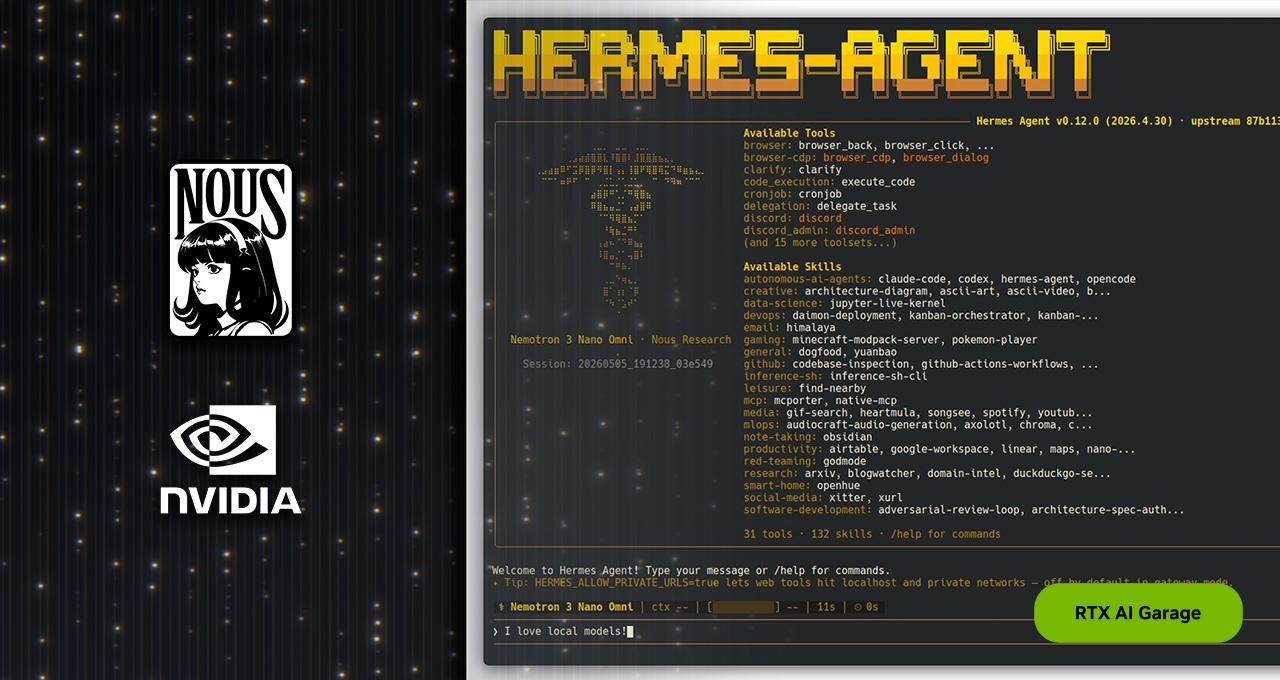
Hermes is designed with two core principles: reliability and self-improvement—traits that have historically challenged AI agents. It is provider- and model-agnostic, meaning it can work with various large language models (LLMs) and cloud services. Critically, Hermes is optimized for always-on local use, making NVIDIA RTX PCs, NVIDIA RTX PRO workstations, and NVIDIA DGX Spark the ideal hardware to run it at full speed around the clock. The combination of a robust agent framework and powerful local hardware unlocks new possibilities for privacy, low latency, and continuous operation.
Key Features That Set Hermes Apart
While Hermes integrates with messaging apps, accesses local files and applications, and runs 24/7 like other popular agents, four standout capabilities distinguish it from the crowd:
- Self-Evolving Skills: Hermes can write and refine its own skills. Whenever it encounters a complex task or receives feedback, it saves its learnings as a skill. This allows the agent to adapt and improve over time without manual intervention.
- Contained Sub-Agents: The agent treats sub-agents as short-lived, isolated workers assigned to specific subtasks. Each sub-agent operates within a focused context and set of tools, keeping task organization tidy and minimizing confusion. This design enables Hermes to run with smaller context windows, which is ideal for local models with limited memory.
- Reliability by Design: Nous Research curates and stress-tests every skill, tool, and plug-in shipped with Hermes. The result is a framework that "just works"—even with 30-billion-parameter-class local models—without the constant debugging required by many other agents.
- Same Model, Better Results: Developer comparisons using identical models across different frameworks consistently show stronger results with Hermes. The difference lies in the framework itself: Hermes is an active orchestration layer, not a thin wrapper. It enables persistent, on-device agents instead of task-by-task execution, leading to more coherent and efficient outcomes.
These features are deeply intertwined with the hardware running the agent. As detailed in the next section, local performance directly depends on the quality of the underlying system.
Why Local Hardware Matters: NVIDIA RTX and DGX Spark
Both the Hermes agent and the underlying LLM are built for local deployment, meaning the user's hardware directly determines the quality of experience. NVIDIA RTX GPUs are purpose-built for such workloads, offering the parallel processing power needed for real-time agent interactions and model inference. The NVIDIA RTX 30 and 40 series, along with professional RTX PRO solutions, provide the memory bandwidth and compute required to run models like Qwen 3.6 efficiently. For even more demanding deployments, the NVIDIA DGX Spark brings data-center-level acceleration to the desktop, enabling round-the-clock operation of Hermes with minimal latency.
Running locally ensures data privacy, reduces cloud dependency, and allows agents to operate without internet connectivity—critical for sensitive or offline applications. The combination of Hermes and NVIDIA hardware represents a significant step toward democratizing advanced AI capabilities.
Qwen 3.6: Compact Models, Data Center-Level Performance
Alibaba's new Qwen 3.6 series of open-weight LLMs is ideally suited for local agents like Hermes. These models, with 27 billion and 35 billion parameters, are compact enough to run on consumer hardware yet outperform their previous-generation counterparts: the 120-billion and 400-billion parameter models. For instance, the Qwen 3.6 35B model requires only about 20GB of memory, while surpassing the 120B model that needed over 70GB. Similarly, the Qwen 3.6 27B is a dense model with more active parameters, matching the accuracy of the 400B model from the earlier series.
This leap in efficiency is crucial for local AI. With Qwen 3.6, users can run data-center-level intelligence on a single NVIDIA RTX GPU or DGX Spark, enabling Hermes to perform complex reasoning, tool use, and self-improvement tasks without sacrificing responsiveness. The synergy between Qwen 3.6's compact architecture and Hermes's orchestration layer creates a powerful ecosystem for agentic AI.
The Future of Agentic AI on Local Devices
Hermes and Qwen 3.6 represent a paradigm shift in how AI agents are built and deployed. The combination of self-evolving capabilities, reliable sub-agent handling, and hardware acceleration from NVIDIA RTX and DGX Spark makes local agentic AI not just feasible but practical. As more developers adopt these tools, we can expect a wave of innovative applications—from personal assistants that learn user habits to autonomous research tools that run offline. The era of always-on, self-improving AI on your desktop has arrived.