Master List Flattening in Python: Techniques and Best Practices
Introduction
Working with multidimensional data structures is a common task in Python. Whether you're dealing with matrices, nested JSON data, or output from algorithms, you often need to flatten a list of lists into a single, one-dimensional list. This seemingly simple operation can be performed in multiple ways, each with its own trade-offs. In this article, we'll explore the concept of list flattening, review various methods with code examples, and discuss when to use each approach. By the end, you'll have a solid understanding of how to convert nested lists into flat ones efficiently.
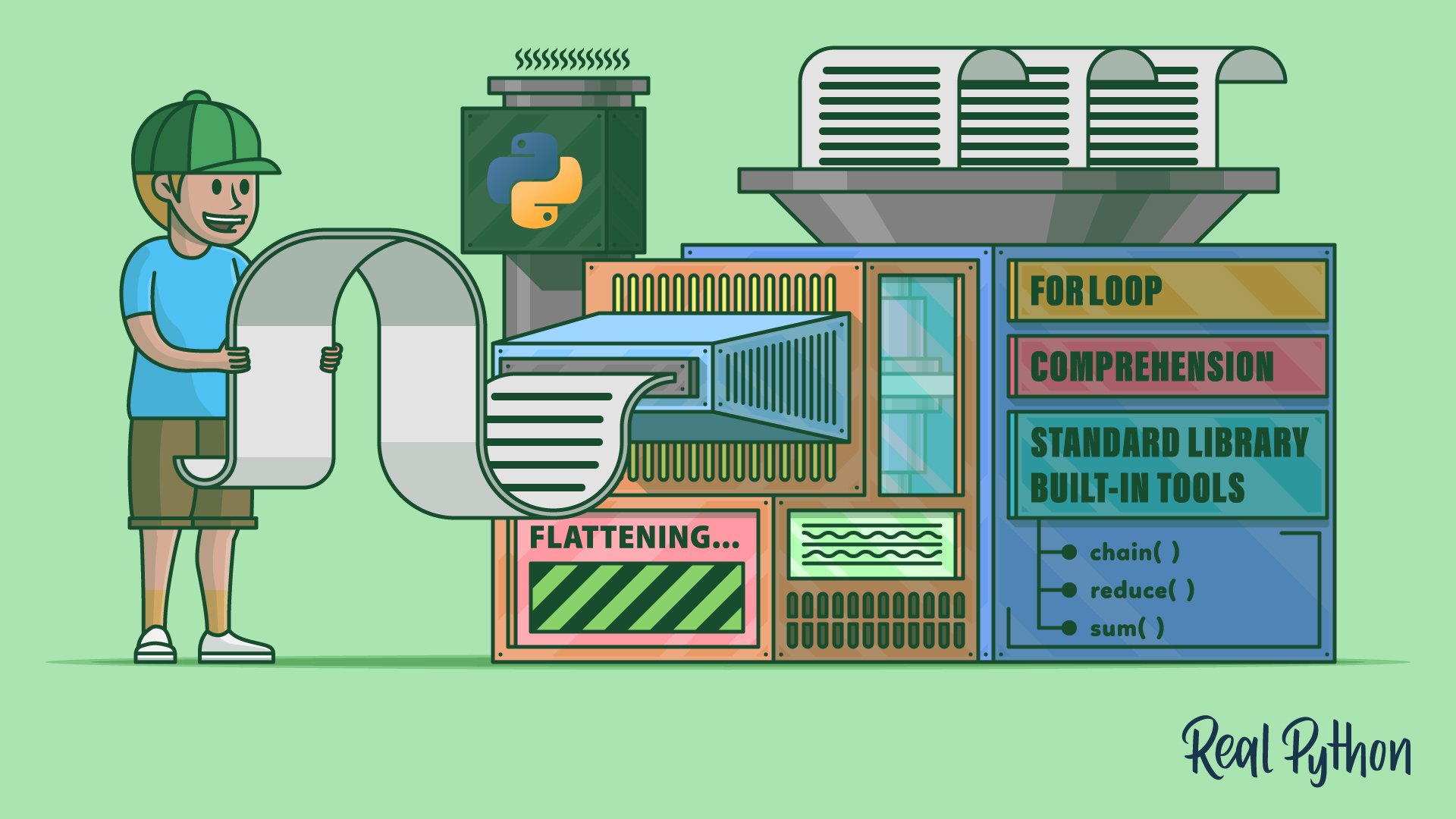
Understanding List Flattening
What Does Flattening Mean?
Flattening a list means converting a multi-level structure into a single level. For example, given a 2D list like [[1, 2], [3, 4], [5, 6]], the flattened version would be [1, 2, 3, 4, 5, 6]. The process can also handle deeper nesting, such as lists within lists within lists, but the core idea remains the same: reduce dimensionality to one.
Why Flatten Lists?
Flattening is useful in many scenarios:
- Data analysis: Many libraries require flat input.
- Compatibility: Functions expecting a 1D iterable.
- Serialization: Easier conversion to formats like CSV.
- Algorithm optimization: Simpler iteration and indexing.
Common Methods to Flatten Lists
Using a Nested Loop
The most straightforward approach is to iterate over each sublist and extend a new list with its elements:
nested = [[1, 2], [3, 4], [5, 6]]
flat = []
for sublist in nested:
    for item in sublist:
        flat.append(item)
print(flat)  # [1, 2, 3, 4, 5, 6]
This method is clear and works for any iterable. However, it can be verbose and slower for large datasets.
List Comprehension
Python's list comprehensions offer a more concise syntax:
flat = [item for sublist in nested for item in sublist]This is functionally identical to the nested loop but expressed in a single line. It's both readable and efficient, making it a popular choice for flattening two-level lists.
Using itertools.chain()
The itertools module provides a powerful function called chain() that can concatenate multiple iterables:
from itertools import chain
flat = list(chain.from_iterable(nested))
chain.from_iterable() is especially handy because it takes a single iterable (your list of lists) and yields each element. This method is memory-efficient because it works lazily.
Using sum() (Not Recommended)
You might see this one-liner:
flat = sum(nested, [])While it works for shallow lists, it's inefficient because it repeatedly creates new lists and concatenates them with O(n²) complexity. Avoid it for any significant amount of data.
Recursive Flattening for Deeply Nested Lists
When you have arbitrary nesting depth, a recursive approach is needed:
def flatten_deep(lst):
    result = []
    for item in lst:
        if isinstance(item, list):
            result.extend(flatten_deep(item))
        else:
            result.append(item)
    return result

deep_list = [1, [2, [3, 4]], 5]
print(flatten_deep(deep_list))  # [1, 2, 3, 4, 5]
This function checks each element; if it's a list, it recursively flattens it; otherwise, it appends the element. While elegant, recursion depth may be limited in Python, and very large nesting can cause a stack overflow. An iterative alternative uses a stack.
Practical Example: Flattening a Matrix
Suppose you have a matrix (list of rows) and you want to extract all elements into a single list for further processing, like plotting or statistical analysis. Using any of the above methods, you can quickly transform matrix = [[1, 2], [3, 4], [5, 6]] into flat = [1, 2, 3, 4, 5, 6]. This is a common data preprocessing step in data science.
Performance Considerations
When choosing a method, consider the size and structure of your data. For two-level lists of moderate size, list comprehensions and chain.from_iterable() are both fast and readable. For very large lists, chain() is more memory-efficient. The nested loop works fine but is less Pythonic. Avoid sum() unless you truly need a one-liner for small lists. Recursion is best for deeply nested data but be mindful of recursion limits.
Test Your Knowledge
Now that you've learned the key techniques, you can reinforce your understanding with a quiz. This interactive assessment will challenge you with code examples and conceptual questions about flattening lists. You'll write code and answer questions that cover converting multidimensional lists into one-dimensional lists.
Conclusion and Further Learning
Flattening a list of lists is a fundamental skill in Python that appears in many real-world applications. By mastering the methods outlined here—nested loops, list comprehensions, itertools.chain(), and recursion—you can handle any flattening task with confidence. For a deeper dive, explore Python Tricks Newsletter, which delivers concise, powerful Python tips straight to your inbox. Happy coding!