Revolutionary Crankless Bicycle Design Breaks 130-Year Cycling Mold
Groundbreaking Prototype Ditches Traditional Pedal Crank
An inventor has successfully tested a crankless bicycle that replaces the circular pedal motion with a linear, more constant propulsion system. The bike, built largely from 3D-printed parts, uses a so-called mechanical rectifier to convert the back-and-forth motion of the rider's legs into rotational force.
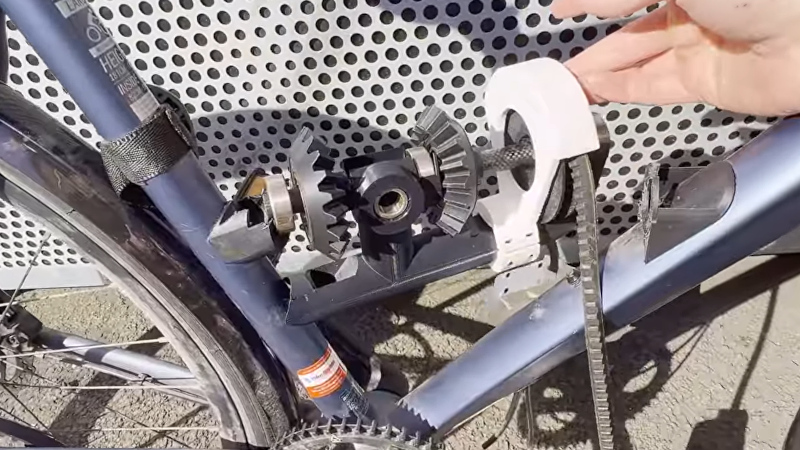
This design represents the first fundamental departure from the bicycle's classic frame and drivetrain in over a century. The prototype, which the inventor describes as 'an exercise in pushing the limits of 3D-print strength', endured multiple failures before finally functioning.
How It Works
Instead of a circular pedal crank, the rider pushes stirrups mounted on a V-belt. A series of gears and freewheels—the mechanical rectifier—converts this linear motion into rotation. 'The idea is to eliminate the dead spots where a conventional crank delivers no power,' the inventor explained.
The key innovation is in the arrangement of the rectifier, which uses a different approach than previous attempts with sinusoidal tracks. The entire drivetrain was designed and iterated using 3D printing, with each prototype shearing under load until the final version held together.
Background: A Century of Static Design
The basic bicycle architecture—two equal wheels, a triangular frame, and a pedal crank with chain—has remained unchanged since the 1890s. While materials and components have improved, the core propulsion mechanism has been virtually untouched.
Only a handful of engineers have dared to challenge this formula. The crankless bicycle is not entirely new; earlier concepts used rotating cylinders with sinusoidal tracks, but none achieved the simplicity of this new linear-to-rotary conversion using standard gears and freewheels.
What This Means
If refined, the design could offer a more efficient and comfortable ride, especially on long distances or uphill. The constant propulsion might reduce knee strain and improve power transfer.
Equally important, the successful use of 3D printing for load-bearing drivetrain parts demonstrates the technology's growing capability. This could accelerate the development of custom, low-volume bicycle components. However, the prototype is still a proof of concept; mass production and real-world reliability remain years away.
Expert Reaction
Dr. Emily Tran, a mechanical engineering professor at Stanford, remarked: 'This is a clever repurposing of existing mechanical principles. The challenge will be durability and efficiency.' She added that the mechanical rectifier concept is novel for bicycles but common in industrial machinery.
The inventor acknowledges the current design is 'not ready for your morning commute' but believes it opens a new direction for human-powered transport. 'We didn't set out to reinvent the wheel—just the way we pedal.'
What Is a Mechanical Rectifier?
A mechanical rectifier is a system that converts reciprocating (linear) motion into unidirectional rotary motion. In this bicycle, it replaces the traditional crank mechanism, allowing the rider's legs to apply force during both the push and pull phases.
The inventor's version uses a combination of one-way bearings (freewheels) and gear trains to ensure continuous rotation. Previous designs for crankless bicycles relied on complex cam tracks or hydraulic systems.
The Road Ahead
Further testing will focus on improving the strength of 3D-printed gears and reducing friction in the rectifier. The inventor is considering a Kickstarter campaign to fund a second-generation prototype.
This is not the first 3D-printed bicycle drivetrain, but it is the first to challenge the fundamental crank mechanism. As 3D printing materials advance, such radical designs may become more common.