China's Humanoid Robot Industry: Growth, Challenges, and the Satisfaction Gap
Introduction: A Boom Under Scrutiny
China has positioned itself as a global powerhouse in humanoid robotics, with over 150 companies racing to dominate the market. In 2025, the country is estimated to have shipped roughly 90% of the world's humanoid robots, a statistic that underscores its manufacturing might. Yet, beneath this impressive surface lies a growing concern: only 23% of buyers report being satisfied with their purchases. This disconnect between production volume and user contentment raises fundamental questions about the industry's trajectory.
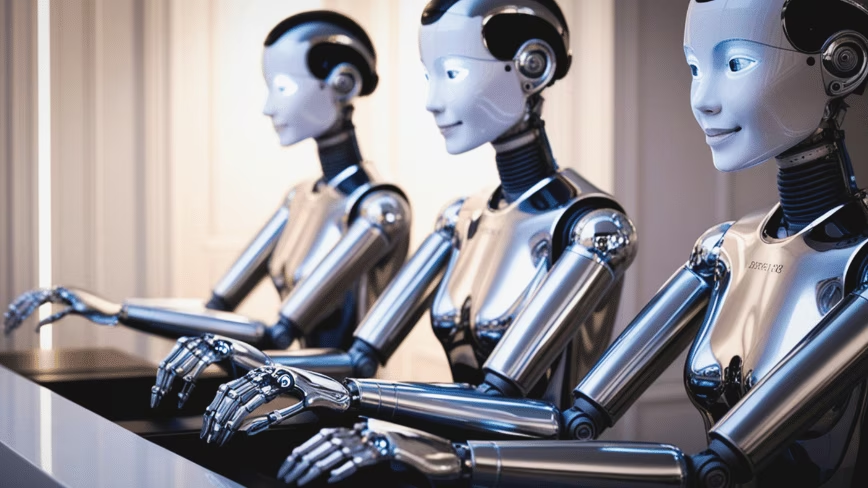
The Boom: Rapid Expansion and High Ambitions
The humanoid robot sector in China has experienced explosive growth, driven by government support, venture capital, and a race to achieve technological breakthroughs. The two largest players, Unitree Robotics and AgiBot, are preparing for initial public offerings (IPOs) that would collectively value them at $13 billion. This demonstrates not only market confidence but also the high stakes involved.
Major Players and Their IPOs
Unitree, known for its dynamic quadruped and bipedal robots, has expanded its product line to include humanoid models capable of complex movements. AgiBot, meanwhile, focuses on AI-driven learning and manipulation. Their IPOs are expected to raise significant capital, allowing these firms to scale production and R&D. However, the valuations reflect a belief in future potential rather than current profitability—a pattern seen in many emerging tech sectors.
Global Dominance in Production
China's supply chain advantages have enabled it to produce humanoid robots at lower costs and higher volumes than any other nation. Morgan Stanley recently doubled its delivery forecast for the Chinese market, citing robust factory automation and logistics demand. Yet, raw numbers can mask quality and usability issues.
The Reality Check: A Satisfaction Crisis
While China ships the vast majority of humanoid robots, user feedback tells a different story. Industry surveys indicate that a staggering 77% of buyers are not satisfied with their robots. This dissatisfaction threatens the entire business model, as repeat purchases and referrals depend on positive experiences.
The 23% Satisfaction Rate
Why are nearly four out of five customers unhappy? The causes are multifaceted and include:
- Limited real-world utility: Many robots still struggle with tasks beyond controlled environments, such as navigating cluttered spaces or understanding complex verbal commands.
- High maintenance costs: Repairs and software updates can be expensive and time-consuming, eroding the perceived value.
- Unmet performance expectations: Vendors often overpromise capabilities, leading to disappointment when robots fail to perform as advertised.
- Integration difficulties: Businesses find it challenging to incorporate humanoid robots into existing workflows and IT systems.
Why Are Users Unhappy? A Deeper Dive
At the core, the technology is simply not mature enough for widespread commercial deployment. While humanoid robots excel at certain repetitive tasks, they lack the cognitive flexibility and reliability required for many real-world applications. For example, a robot designed for warehouse work may struggle when faced with unexpected obstacles or product variations. Moreover, the current user interface often requires specialized training, limiting adoption among non-technical staff.
Another factor is the price point. Even the most affordable humanoid robots cost tens of thousands of dollars. For small and medium enterprises, this represents a significant investment with uncertain returns. When the robot fails to deliver on its promises, the financial blow can be severe.

The Road Ahead: Building Trust and Refining Technology
The humanoid robot industry in China stands at a crossroads. The production capacity is there, but it must be matched by genuine utility. To bridge the satisfaction gap, companies need to focus on three key areas:
- Improving reliability and robustness: Robots must function consistently in diverse conditions, from factories to homes.
- Enhancing user experience: Simplified interfaces, better training materials, and responsive customer support can help build trust.
- Setting realistic expectations: Honest marketing about what a robot can and cannot do will align buyer expectations with actual performance.
Lessons from Other Tech Booms
History offers cautionary tales. The dot-com bubble saw many companies with high valuations but little profit—until the market corrects itself. Similarly, the early days of personal computers involved steep learning curves and frequent breakdowns before they became mainstream tools. Today's humanoid robots may follow a similar trajectory if developers iterate based on user feedback rather than hype.
What Needs to Change
Collaboration between hardware manufacturers, software developers, and end-users is essential. Open standards and modular designs could lower costs and encourage innovation. Additionally, government incentives might shift from production volume to quality metrics, rewarding companies that achieve high satisfaction scores.
In the longer term, the dissatisfaction crisis could actually be a catalyst for improvement. As customers become more vocal, firms will be forced to invest in better design, testing, and after-sales service. The result may be a more mature industry that finally delivers on its promise.
Conclusion: A Balanced Future
China's 150+ humanoid robot companies have achieved remarkable feats in production and finance. But the 23% satisfaction rate serves as a stark reminder that innovation must be measured by impact, not just output. If the industry can pivot from quantity-driven growth to quality-driven development, it has the potential to transform sectors ranging from healthcare to logistics. Until then, the humanoid robot boom remains an enthusiastic experiment in need of more realistic grounding.